When an outbreak hits, every hour counts
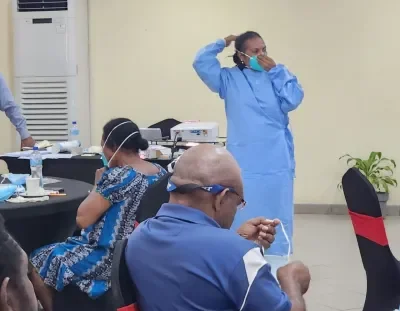
A multi-year investment will train frontline teams across eight Papua New Guinea (PNG) provinces to rapidly detect, investigate, and contain disease outbreaks in emergencies before they spiral.
When disease strikes in a remote PNG province, the people who respond first are not specialists flown in from the capital. They are local health professionals, clinicians, administrators, and community officers. The Field Epidemiology in Action (FEiA) team from the School of Medicine and Public Health has been working with the World Health Organization (WHO) and National Department of Health (NDoH) in Papua New Guinea (PNG) to train provincial Rapid Response Teams (RRT) to respond to disease outbreaks and other health alerts in their communities.
RRT are multidisciplinary groups embedded within Provincial Health Authorities, activated when disease outbreaks, natural disasters, or other urgent health threats emerge. The team are trained to investigate, respond to and control disease outbreaks. They are deliberately broad in composition: clinicians, epidemiologists, surveillance officers, laboratory specialists, environmental health officers, and community engagement officers, alongside logistics coordinators, procurement and finance officers, and administrators. An effective response needs more than doctors. It needs the finance officer who can release emergency funds, the logistics lead who knows how to move supplies across rugged terrain, and the community officer who earns the village’s trust.
Through a new surge of funding from the Australian Government under the Public Health Operations in Emergencies for National Strengthening in the Indo-Pacific (PHOENIX) program, this work is expanding, to train teams in eight provinces. PHOENIX is part of the National Critical Care and Trauma Response Centre (NCCTRC) and funds programs to strengthen pandemic preparedness and outbreak response in the region. The first provincial RRT Phase 3 training, including a Tabletop Exercise involving a simulated outbreak, has just been completed. RRT members from Eastern Highlands Province and Morobe Provine gathered in Goroka to improve their skills and practice for a public health emergency.
This isn't just about classroom learning. It’s about building a "muscle memory" for crisis. It’s not about outside experts coming in; it’s about equipping local facilitators to lead the training. These teams will participate in table-top exercises that bring together disease specialists, disaster managers, and emergency medical staff to practice and strengthen their new skills. In 2027, for the first time a real-world simulation exercise will be conducted to test operations in two provinces.
Without this investment, the progress made in recent years risked stalling. Provinces that had completed earlier training phases would have been left without the tools needed to reach full operational readiness. This new funding ensures that provinces are equipped to deliver the program into the future, and respond to public health emergencies in a coordinated and effective way.
“Rapid Response Teams are the backbone of PNG's outbreak response. They are the clinicians, the epidemiologists, the environmental health officers who are already in the province when an alert comes in. Our role is to make sure they have the skills and confidence to act.” Associate Professor Tambri Housen, Field Epidemiology in Action
About Field Epi in Action